The 1825 Tunstall Whale Stranding and Dissection
The WhaleThe 1825 Tunstall Whale Stranding and Dissection brought a fifty-eight-foot sperm whale from the North Sea onto the Holderness coast, where its arrival became a public spectacle and set in motion an effort to study and preserve its remains.
Discovery and Arrival at Tunstall
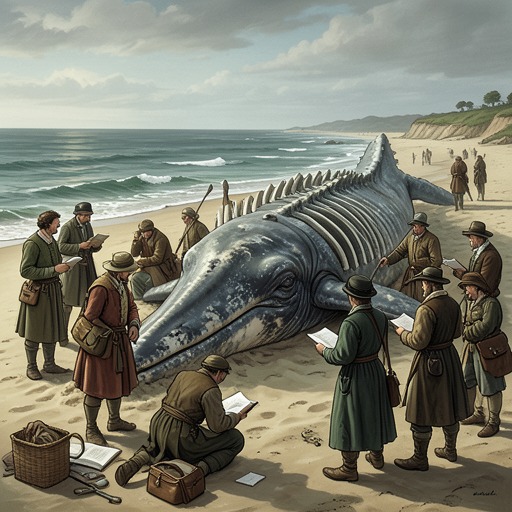
In April 1825, fishermen saw a dead whale floating off Holderness and steered clear, concerned that it might damage their boats. The tide carried it ashore, and on Thursday afternoon, 28 April, it was cast onto Tunstall beach beneath the low cliffs. Reverend Christopher Sykes, an amateur scientist, arrived the following day to record its measurements. By Sunday, about a thousand people had gathered to see the animal, identified as a bull sperm whale. Its arrival drew notice across the region, turning an otherwise familiar coastal occurrence into a remarkable local event.
Public Specimen and Scientific Examination
The whale’s condition changed rapidly after it came ashore. Its skin had peeled away in places, exposing a layer between skin and blubber, and the jaw had been dislocated. As people gathered around it, some removed material from the body. The carcass soon became difficult to recognize as an intact animal, turning the spectacle into a hurried disassembly before a formal examination could be completed.
The remains nevertheless offered both commercial and scientific value. The blubber was estimated to be worth £500, the head yielded eighteen gallons of spermaceti, and the meat could have fed several families for weeks. Yet the find’s greater importance lay in what it might reveal about the animal. Dr James Alderson was appointed to conduct a post-mortem, and the surviving parts were brought to his laboratory in Hull in separate installments.
Alderson, a Fellow of Pembroke College, Cambridge, and of the Cambridge Philosophical Society, treated the whale as an opportunity to investigate disputed knowledge about its kind and advance his academic standing. He contrasted the animal’s massive soft tissues with its skeleton, observing that the large cheeks and jaw had no proportionate equivalent in the bones of its head. The examination thus set the whale’s external scale against the structure beneath it, while the fragmented state of the specimen limited what could be learned.
Unanswered Questions and the Specimen’s Afterlife
Alderson could not determine what had killed the whale. Its internal organs had been removed quickly to clear the skeleton, leaving him unable to examine every part. His investigation recorded a five-inch section of a swordfish spear in the animal’s back and a separate opening apparently made by a harpoon, but neither finding resolved the cause of death.
The remains were buried in a series of pits, with the intention that the whale be preserved for posterity. Instead, the bones were neglected after they were unearthed: in 1829 a naturalist found them piled irregularly in a field, and seven years later the geologist John Phillips found them in a barn, with the tail bones hanging in a tree. In 1836, Edward Wallis, a surgeon, anatomist, and astronomer, was commissioned to assemble the skeleton, giving the dismembered specimen a further life as an articulated display.
Ownership and the Whale’s Afterlife
The whale’s fate was shaped not only by scientific interest but by the rules governing beached animals. Once it came ashore, it became the property of the Lord Paramount of the Seigniory of Holderness, the Squire of Burton Constable Hall. A dead animal that had arrived from the open sea was thus absorbed into a local estate, its remains subject to the authority of a landowner as well as the curiosity of investigators and visitors.
The plan to preserve the specimen had a precedent: in 1766, a fifty-foot sperm whale stranded alive at Seaton, where its cries were reportedly heard for miles, and its skeleton was later displayed in the undercroft of Durham Cathedral after the Bishop of Durham claimed it. The Tunstall whale, too, was intended for perpetuity, but its remains were buried in pits rather than promptly assembled for display. The contrast makes preservation less a guaranteed scientific outcome than an uncertain passage from animal to property, from property to specimen, and from specimen to neglected bones.